
Introduction
Airports run like small cities—thousands of people moving through check-in halls, security lanes, retail zones, corridors, gates, baggage belts, and staff-only areas. And yet, many airports still rely on the same approach they used years ago: CCTV screens watched by humans, with action taken only after something goes wrong.
That model doesn’t scale anymore.
Cognitive infrastructure changes the purpose of surveillance. Instead of only recording what happened, your facility starts understanding what’s happening—and helps teams respond in real time.
This blog breaks down how airports can convert existing CCTV into a facility intelligence layer that improves safety, passenger flow, and operational control.
What “Cognitive Infrastructure” Means in an Airport
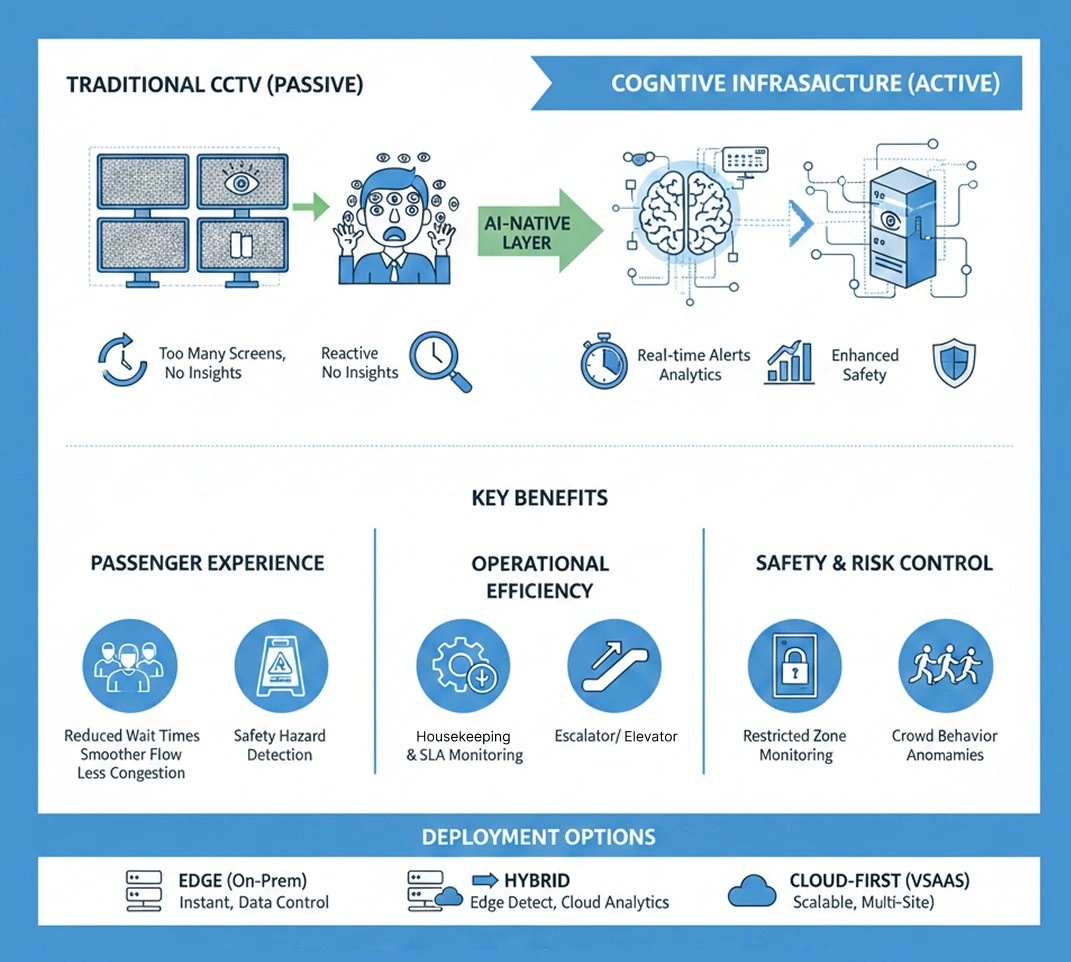
Cognitive infrastructure is an AI-native layer that sits on top of your existing facility systems—cameras, sensors, access control, building systems—and turns raw signals into real-time insights and actions.
In simple terms:
CCTV watches. Cognitive infrastructure understands and acts.
It detects patterns (queues building up, crowds forming, restricted entries, safety hazards), prioritizes what matters, alerts the right team instantly, and creates analytics that help you improve operations over time.
Why Traditional CCTV Falls Short in Modern Airports
CCTV is valuable, but it’s fundamentally passive.
Common airport CCTV challenges
Too many screens, too few eyes: Operators can’t actively monitor hundreds of feeds.
Reactive by design: Most incidents are found after the fact, during investigation.
Alert fatigue: Even when basic alerts exist, they’re noisy and not context-aware.
No operational insights: CCTV doesn’t tell you queue trends, SLA performance, or response time impact.
Airports need continuous situational awareness—not just footage.
System Architecture Flow: From Cameras to Decisions
1) CCTV / IP Cameras (ONVIF / RTSP)
Capture live airport activity across terminals, gates, corridors continuously.
2) Edge AI (Analyze Live Video)
Processes video locally to detect events with low latency.
3) Facility Platform (Detect + Alert + Dashboard)
Converts detections into alerts, dashboards, and operational insights.
4) Integrations (VMS / VSaaS, Access Control, BMS, Tickets)
Connects intelligence with existing airport systems for coordinated response.
5) Action + Reports (Respond, Measure Performance)
Drives faster responses and measurable improvements across airport operations.
Key Airport Facility Use Cases
| S. No | Airport Facility Use Case | What it Detects | What it Enables |
|---|---|---|---|
| 1 | Queue & Congestion Detection (Check-in, Security, Immigration) | Queue length growth, Estimated wait time, Counter/lane congestion, Unusual surges | Open new counters/lanes based on thresholds, Dispatch staff when wait time exceeds SLA, Heatmaps of recurring congestion zones |
| 2 | Safety Hazard Detection (Slips, Spills, Blocked Paths) | Wet floor or spill-like patterns, People slipping or falling (where feasible), Blocked walkways and exit routes | Instant alerts to housekeeping and safety teams, Evidence capture and reporting, Reduced incident frequency over time |
| 3 | Housekeeping & SLA Monitoring (Restrooms & Public Areas) | Cleaning staff presence and time-in-zone, Missed rounds or delayed cleaning cycles, Overcrowding near restrooms | SLA dashboards by terminal or zone, Workload balancing, Improved passenger experience and hygiene compliance |
| 4 | Escalator/Elevator Downtime & Crowd Impact | Stalled escalator patterns (no movement + crowd buildup), Elevator queue anomalies, Accessibility risks for elderly or disabled passengers | Early detection before complaints rise, Priority-based maintenance routing, Crowd diversion planning |
| 5 | Perimeter & Restricted Zone Monitoring (Sterile Areas) | Entry into restricted zones, Tailgating near doors (with integration), Unusual presence after hours | Security alerts with snapshot and location, Faster verification with fewer false alarms, Audit-ready event logs |
| 6 | Crowd Behavior Anomalies (Running, Panic, Fights) | Sudden crowd movement shifts, Running in unusual areas, Aggressive behavior or clustering anomalies | Early intervention, Faster incident response, Safer terminals during disruptions |
Deployment Options for Airports
Every airport has different rules for privacy, network bandwidth, and data hosting. That’s why cognitive infrastructure should be deployable in multiple ways—without forcing a one-size-fits-all model.
Common Deployment Models
1) Edge (On-Prem)
AI runs inside the airport network for instant alerts, low bandwidth usage, and maximum data control.
2) Hybrid
Real-time detection happens at the edge, while centralized dashboards, analytics, and reporting run on a shared server or cloud.
3) Cloud-First (VSaaS)
Video and analytics are managed in the cloud for easy scaling, multi-terminal/site visibility, and simpler maintenance—when policy allows.
Most airports begin with a pilot in one high-impact area (like security or check-in), prove results, then expand zone by zone across the facility.
Integration Checklist
| Integration Area | What to Align During Rollout |
|---|---|
| Camera Streams | RTSP / ONVIF access, stream quality, frame rate, camera health |
| VMS & Recording | Existing VMS integration, recording rules, retention policies |
| Zone Mapping | Define terminals, gates, lanes, corridors, and restricted areas |
| Alert Delivery | SMS, email, mobile app, control room dashboards |
| Incident Workflow | Ticketing tools, duty rosters, escalation paths |
| Optional Systems | Access control, BMS integration, PA or signage triggers |
Why Airports Invest in Cognitive Infrastructure
The value is practical and measurable. Airports adopt cognitive infrastructure because it improves daily operations in three core ways:
Better passenger experience: reduced wait times, smoother movement, and fewer congestion points.
Higher operational efficiency: smarter staffing decisions, less manual monitoring, and quicker responses.
Stronger safety and risk control: earlier hazard detection, fewer incidents, and clearer evidence for reviews.
It’s not just a security upgrade—it’s a way to run the entire airport more intelligently.
Conclusion
Airports don’t need more screens—they need more situational intelligence. By transforming CCTV from passive recording into real-time cognition, facility teams can detect issues early, respond faster, and continuously improve operations using measurable data.
Whether it’s reducing queues at security, spotting hazards before incidents happen, or keeping restricted zones protected, cognitive infrastructure helps airports move from reactive management to proactive control. Start small with a pilot in a high-impact area, prove the outcomes, and scale across terminals with repeatable use case templates.
The result: safer facilities, smoother passenger flow, and smarter airport operations—powered by the systems you already have.